

Published
October 25, 2026
by Joe Scerri, Owner
Concrete subfloors are common in apartments, condominiums, and residential construction, particularly throughout New York City.
For homeowners considering hardwood flooring, one of the most common questions is whether real wood can be installed directly over concrete.
The answer is yes, but a successful installation requires careful material selection, proper subfloor preparation, and an installation method suited to the conditions.
Understanding the relationship between hardwood flooring and concrete can help homeowners avoid costly mistakes and make more informed decisions about their flooring projects.
Hardwood flooring can be installed over concrete when the flooring product, substrate conditions, and installation system are compatible.
However, not every type of hardwood flooring is suitable for direct installation over a concrete slab.
Engineered hardwood is frequently selected for concrete applications because its layered construction provides greater dimensional stability than conventional solid hardwood.
Solid hardwood may also be installed over concrete using certain approved systems, such as appropriately designed wood subfloors or other manufacturer-approved assemblies.
The important distinction is that concrete requires different installation considerations than a traditional plywood subfloor.
Moisture conditions, flatness, adhesive compatibility, and building requirements must all be evaluated before installation begins.
Engineered hardwood flooring consists of a genuine hardwood surface bonded to a supporting core.
This construction helps reduce dimensional movement associated with changes in moisture and temperature.
Because concrete can transmit moisture and respond differently to environmental conditions than wood, engineered hardwood is often a practical choice for these installations.
Many engineered flooring products are specifically designed for glue-down or floating installations over properly prepared concrete.
However, engineered construction does not make hardwood waterproof or eliminate moisture-related risks.
The flooring manufacturer's specifications should always determine whether a particular product is appropriate for the project.
Moisture is one of the most important considerations when installing hardwood flooring over concrete.
Even concrete that appears completely dry can contain moisture or allow moisture vapor to move through the slab.
Excessive moisture can contribute to adhesive failure, dimensional changes, cupping, and other flooring problems.
Before installation, the concrete should be evaluated using moisture testing methods appropriate for the flooring and installation system.
Depending on the manufacturer's requirements, testing may involve in-situ relative humidity measurements or other approved procedures.
If moisture levels exceed acceptable limits, an appropriate moisture mitigation system may be required.
These systems must be compatible with the concrete substrate, flooring adhesive, and selected hardwood product.
Simply allowing the surface to dry or applying an arbitrary coating is not a substitute for proper moisture evaluation.
A successful installation begins with a properly prepared concrete surface.
The subfloor must be structurally sound, clean, sufficiently dry, and flat within the flooring manufacturer's specified tolerances.
High spots may require grinding, while low areas may need compatible patching or leveling materials.
Contaminants such as paint, curing compounds, adhesive residue, and other surface materials can interfere with bonding and may need to be removed using approved preparation methods.
Cracks and other substrate defects should also be evaluated before installation.
Preparation requirements vary depending on the flooring product and installation system, making professional assessment an important part of the process.

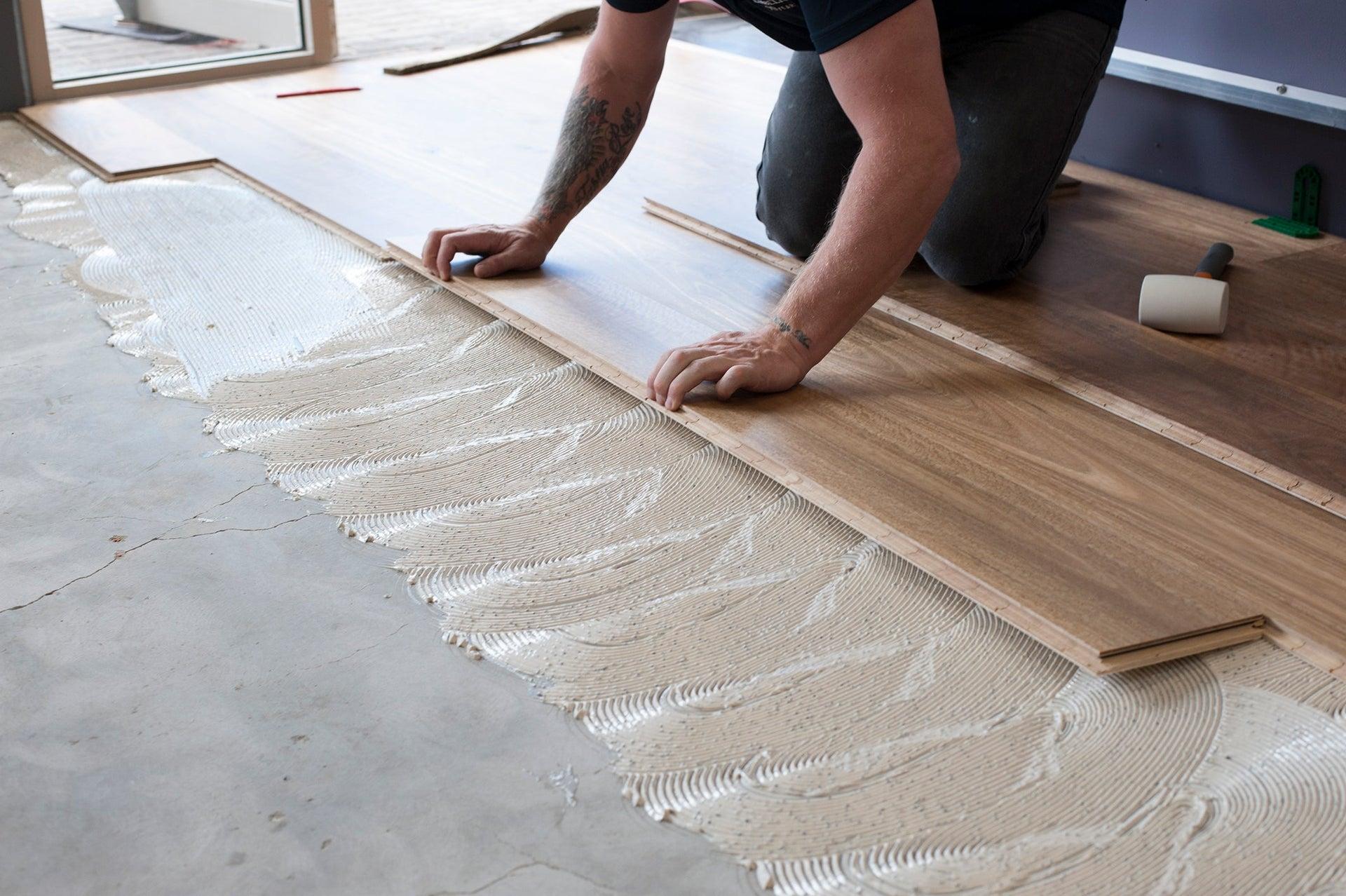
Glue-down installation is a common method for securing engineered hardwood flooring directly to a prepared concrete substrate.
This process uses an adhesive specifically approved for the flooring product and concrete conditions.
The adhesive must be applied using the correct trowel dimensions and installation procedures to achieve the required coverage and transfer.
Some adhesive systems also provide moisture-control properties when applied according to their manufacturer's specifications.
However, not every flooring adhesive functions as a moisture barrier, and moisture protection should never be assumed.
A properly executed glue-down installation can provide a secure flooring assembly with minimal movement when the substrate and materials meet the required conditions.
Floating installation is another option for certain engineered hardwood flooring products.
Rather than being bonded directly to the concrete, the flooring is installed as an interconnected assembly over an approved underlayment.
Depending on the product, boards may use a locking system or an approved edge-gluing method.
The underlayment may provide moisture-vapor control, acoustic performance, or other functions, depending on its construction.
Floating installations require appropriate expansion space around walls and other fixed objects.
They must also comply with the flooring manufacturer's limitations regarding room dimensions, transitions, and heavy fixed installations.
Not every engineered hardwood product is approved for floating installation.

In Manhattan apartments and condominiums, hardwood flooring installation may involve additional requirements beyond the condition of the concrete.
Many buildings establish specific rules concerning sound transmission, approved flooring assemblies, renovation procedures, and contractor access.
Acoustic underlayments or other sound-control systems may be required to satisfy building standards.
These requirements can influence whether a glue-down, floating, or alternative installation system is appropriate.
Before selecting flooring materials, homeowners should review applicable building requirements and coordinate with property management when necessary.
A flooring assembly should be selected based on both the manufacturer's installation specifications and the building's requirements.
There is no single installation method that is ideal for every concrete subfloor.
The appropriate approach depends on the condition of the slab, moisture levels, flooring construction, acoustic requirements, and the intended use of the space.
Glue-down installations may be preferred for certain premium engineered hardwood products, while floating systems can be appropriate where permitted by the manufacturer and building.
In some situations, additional subfloor construction or moisture mitigation may be necessary before hardwood flooring can be installed.
The goal is to select a complete flooring system that provides reliable performance rather than choosing an installation method based on convenience alone.
Installing hardwood flooring over concrete is entirely possible, but the quality of the finished floor depends heavily on the preparation and decisions made before installation.
Moisture testing, substrate preparation, flooring selection, and installation compatibility all contribute to long-term performance.
At Scerri Quality Wood Floors, we help homeowners, architects, designers, and contractors navigate hardwood flooring selection and installation requirements throughout Manhattan and Westchester County.
Whether you're planning a condominium renovation or selecting engineered hardwood for a residential project, understanding the conditions beneath the floor is an essential first step.
Contact Scerri Quality Wood Floors to discuss hardwood flooring options for your next installation or renovation project.

© 2026 Scerri Quality Wood Floors


