

Published
September 30, 2026
by Joe Scerri, Owner
A beautiful hardwood floor starts long before the first board is installed. Moisture testing, subfloor preparation, acclimation, and the right adhesive system all play an important role in how a floor performs over time.
This is especially important in New York homes, apartments, and renovations where hardwood may be installed over concrete, plywood, sound-control materials, or a combination of different substrates. Understanding the conditions below the finished floor allows installers to address potential problems before they become expensive repairs.
Wood naturally responds to its environment. When humidity increases, wood can absorb moisture and expand. When conditions become drier, it can release moisture and contract.
Some seasonal movement is normal. Problems arise when flooring is installed before the wood, subfloor, and surrounding environment are ready.
Excessive moisture can contribute to cupping, buckling, gaps, adhesive problems, and other issues after installation. That is why professional preparation should involve more than simply delivering the flooring and waiting a certain number of days.
Moisture testing helps determine what is actually happening at the jobsite.
There are two important areas to consider: the flooring itself and the material underneath it.
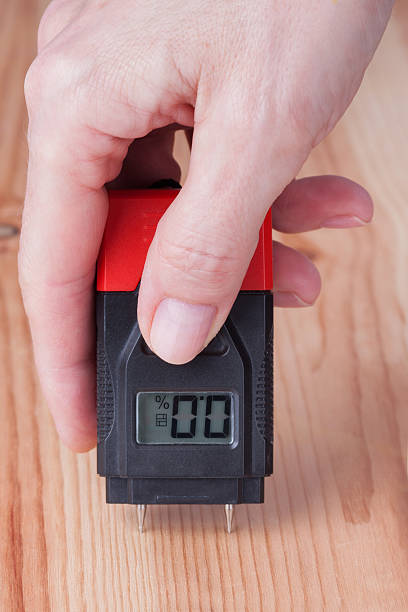
For wood flooring, a moisture meter can be used to measure the moisture content of the boards. Multiple readings should be taken rather than relying on a single piece of flooring.
The subfloor or concrete slab also needs to be evaluated using the appropriate testing method. Concrete presents a different moisture concern than wood because moisture vapor can move through the slab and affect the flooring system installed above it.
The important part for homeowners is not memorizing specific readings. It is understanding that the flooring, substrate, and environment need to be suitable for the specific flooring and installation system being used.
Testing identifies the conditions. Proper preparation addresses them.
When installing over concrete, moisture mitigation may be necessary before flooring or other components of the subfloor system are installed. Professional primers, moisture barriers, and preparation products can help protect the flooring system from moisture moving through the concrete.
One system we look to for this type of preparation is LOBA-WAKOL. The company offers products designed for different stages of flooring preparation and installation, including moisture-control products, primers, leveling compounds, and flooring adhesives.
Using products designed as part of a compatible system can be an advantage on more demanding installations. Instead of viewing moisture protection, leveling, and adhesion as unrelated steps, each layer can be selected to work with the next.
Scerri Quality Wood Floors is not sponsored by or partnered with LOBA-WAKOL. We highlight the company because its product systems provide a useful example of the professional preparation options available for hardwood flooring installations.
Controlling moisture is only one part of preparing a subfloor. The surface also needs to meet the flatness requirements of the flooring and installation system.
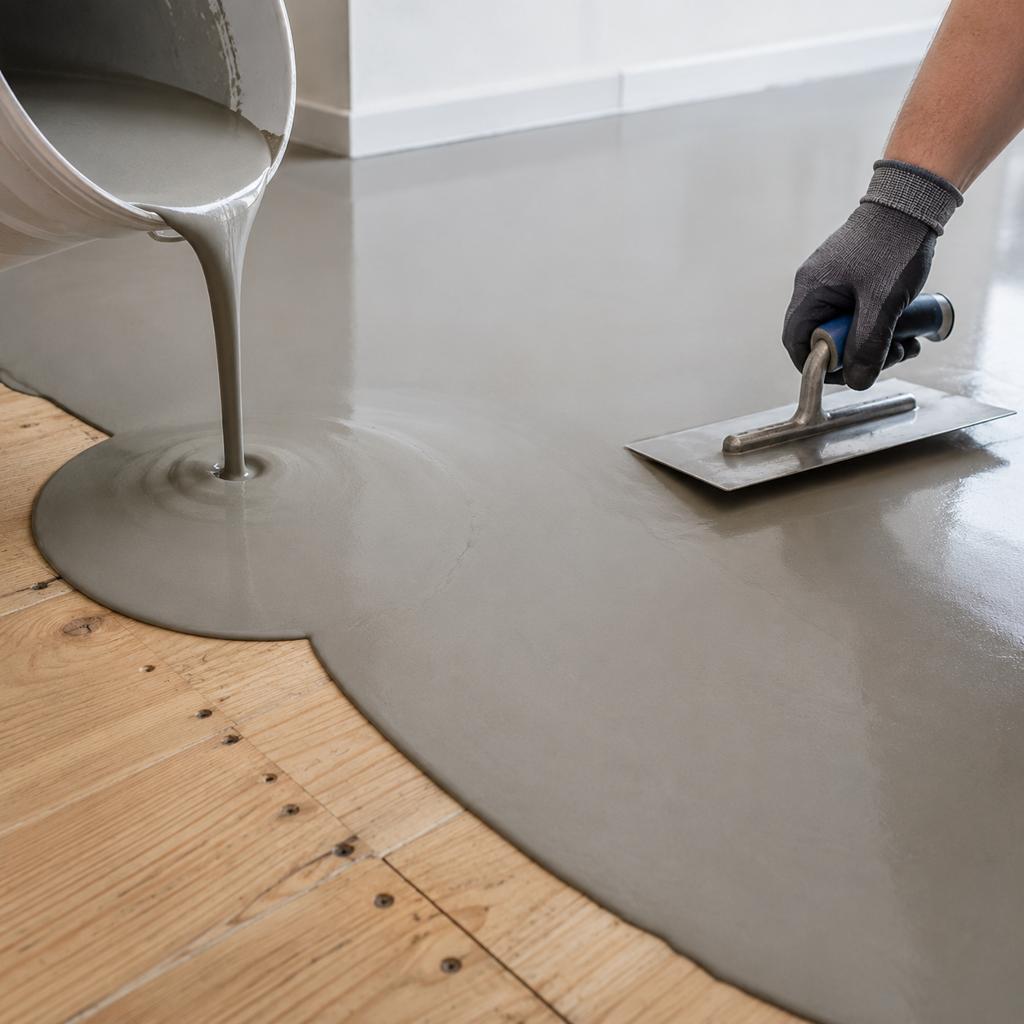
Low areas, uneven sections, and other irregularities can create problems underneath the finished hardwood. Depending on jobsite conditions, primers and cementitious leveling or patching products may be used to create a more suitable substrate.
The goal is not simply to make the concrete look smooth. It is to create a stable and sufficiently flat surface for everything that will be installed above it, including sound-control materials, plywood assemblies, adhesives, and engineered hardwood.
This preparation becomes particularly important with wide-plank engineered flooring, where inconsistencies underneath the floor can become more noticeable.
Certain installations require another layer between the concrete and finished hardwood.
One method is to create a floating plywood subfloor by laminating layers of plywood together on site. Rather than mechanically fastening the plywood through the concrete or certain underlayments, the plywood layers can be bonded together to create a stable substrate above the prepared surface.
This approach can be particularly useful when the flooring assembly incorporates sound-control materials or when mechanically fastening through the concrete or underlayment is undesirable.
The exact construction depends on the building, flooring, sound requirements, substrate conditions, and manufacturer specifications. There is no single subfloor assembly that should automatically be used for every project.

Choosing the correct adhesive is another important part of the installation.
Two categories commonly encountered in hardwood flooring are urethane and polymer-based adhesives. Both can provide strong bonds, but strength alone does not determine whether an adhesive is right for a particular floor.
Wood naturally experiences some movement as temperature and humidity change. A flooring adhesive therefore needs to provide strong adhesion while maintaining the flexibility appropriate for the flooring system.
Urethane adhesives have a long history in hardwood flooring and can provide excellent bonding performance. Modern polymer-based adhesives can also provide strong adhesion while maintaining elasticity to accommodate normal movement within the flooring assembly.
This combination of strength and flexibility is particularly important as flooring experiences seasonal changes in humidity and indoor climate.
Moisture resistance, flexibility, working characteristics, flooring type, substrate, and compatibility with other preparation products should all be considered when selecting an adhesive.
The best adhesive is not simply the strongest product available. It is the product that works correctly with the entire flooring system.
Acclimation is often misunderstood as simply leaving boxes of flooring inside a home for a few days.
Proper acclimation is about conditions, not just time.
The building should be brought to normal living conditions with temperature and relative humidity controlled before installation. Flooring should be stored according to manufacturer requirements and protected from unusual moisture, extreme temperatures, and active construction conditions.
Moisture readings can then help determine whether the flooring has reached appropriate conditions for the space rather than relying solely on a predetermined number of acclimation days.
Engineered flooring is generally more dimensionally stable than solid hardwood, but that does not eliminate the need for proper jobsite preparation. Both products perform best when the environment, substrate, and flooring have been properly evaluated before installation.
Before installation begins, we want the major variables accounted for.
The space should be at appropriate temperature and humidity conditions. Flooring and subfloor conditions should have been checked. Any required moisture mitigation, priming, leveling, or patching should be complete. The subfloor assembly should be stable and ready, and the correct adhesive and installation materials should be on site.
It is also important to confirm that other construction work will not introduce unexpected moisture or interfere with the flooring installation.
Taking the time to complete these steps can prevent much larger problems later.
.jpg)
Homeowners naturally focus on what they can see: the species, grade, plank width, color, finish, and layout. But some of the most important parts of a hardwood floor are eventually hidden underneath it.
Moisture testing, primers and sealers, leveling, subfloor construction, adhesive selection, and acclimation all contribute to the long-term performance of the finished floor.
At Scerri Quality Wood Floors, we believe proper installation begins with understanding the entire flooring system, from the conditions of the substrate below to the hardwood you ultimately see and enjoy.
Planning those details before installation helps create a floor designed not only to look beautiful on day one, but to perform for years to come.

© 2026 Scerri Quality Wood Floors


