
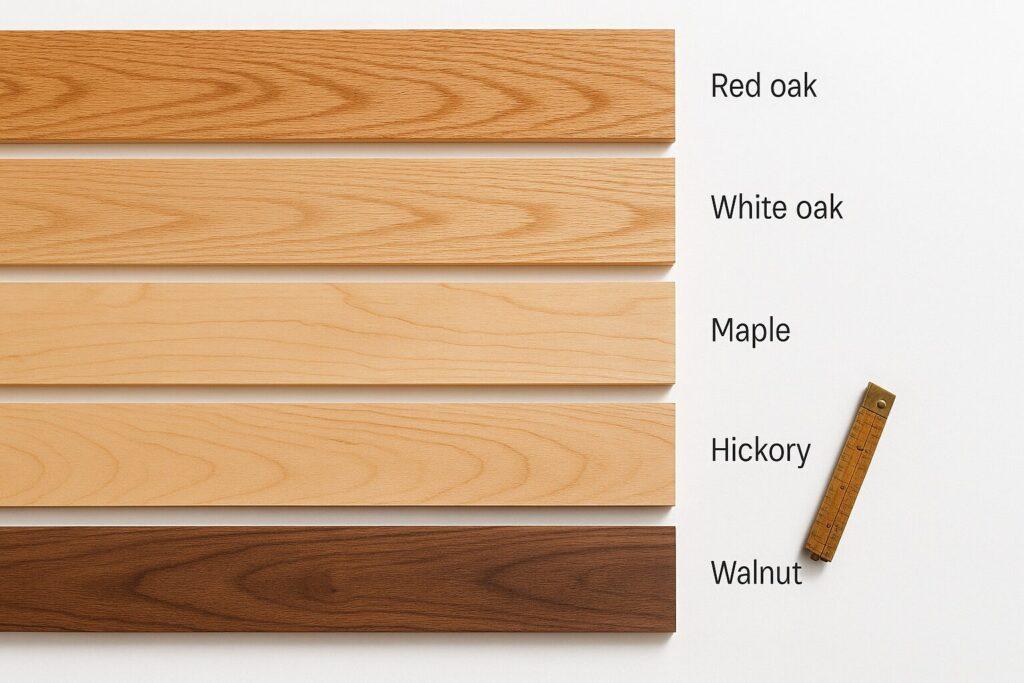

Published
October 25, 2026
by Joe Scerri, Owner
When choosing hardwood flooring, homeowners often compare wood species based on appearance, color, grain patterns, and price.
However, another important characteristic to consider is hardness.
Different wood species have varying levels of resistance to dents and indentations, which can influence how they perform under everyday use.
One of the most widely recognized methods for comparing wood hardness is the Janka hardness test.
Understanding what these ratings mean, and what they don't, can help homeowners make more informed decisions when selecting hardwood flooring.
The Janka hardness test measures a wood species' resistance to indentation.
During the test, a steel ball measuring approximately 0.444 inches in diameter is pressed into a wood sample until half of the ball is embedded in the surface.
The amount of force required to achieve this indentation determines the wood's Janka hardness rating.
In the United States, results are commonly expressed in pounds-force (lbf).
A higher Janka rating indicates that a wood species generally offers greater resistance to indentation under the standardized test conditions.
However, the rating does not measure every aspect of hardwood flooring durability.
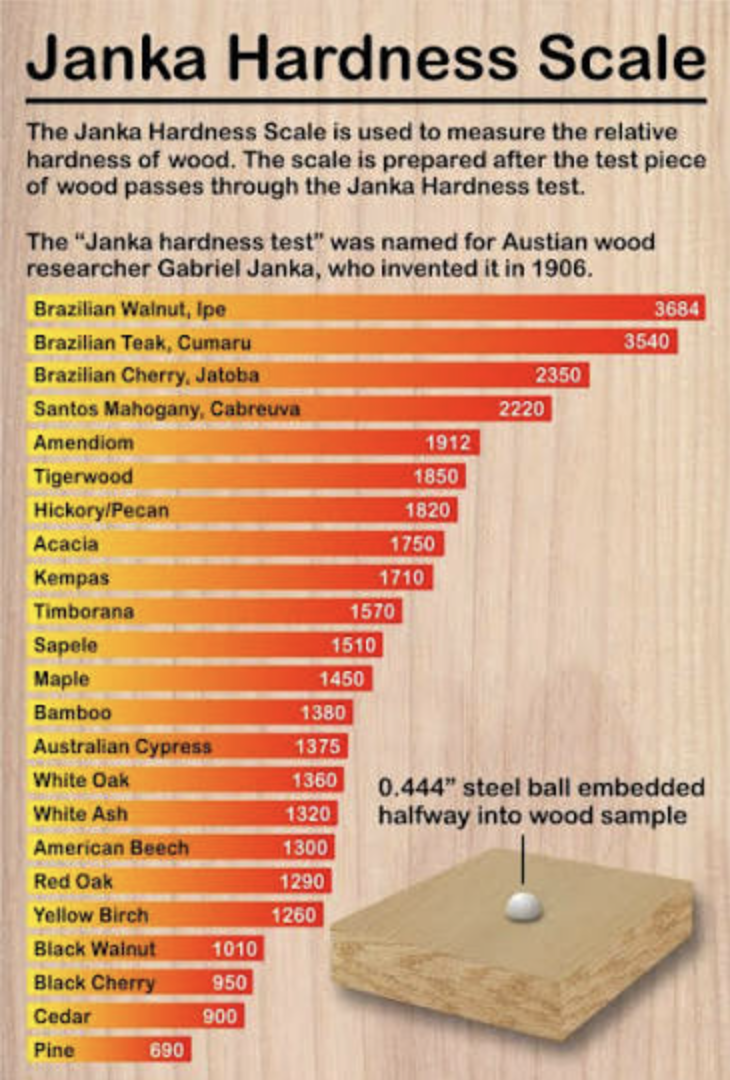
Different hardwood species can have significantly different hardness ratings.
Below are commonly published approximate Janka hardness values for several species used in residential flooring.
Wood Species
Janka Hardness
American Cherry 950 (lbf)
American Walnut 1,010 (lbf)
Red Oak 1,290 (lbf)
White Oak 1,360 (lbf)
Hard Maple 1,450 (lbf)
White Ash 1,320 (lbf)
Hickory 1,820 (lbf)
Brazilian Cherry (Jatoba) 2,350 (lbf)
These values are general references rather than guarantees of performance for an individual flooring product.
Hardness can vary with the wood's growth conditions, moisture content, and the particular material being tested.
A higher Janka rating does not automatically make one wood species a better flooring choice than another.
While harder species generally resist indentation more effectively, flooring performance depends on several additional factors.
Wood construction, surface finish, installation quality, and environmental conditions all influence how a floor performs over time.
For example, white oak is widely used in premium residential flooring because it offers a practical combination of hardness, attractive grain patterns, and versatility.
American walnut has a lower Janka rating, yet remains a desirable material for luxury interiors because of its rich natural color and distinctive appearance.
The best flooring choice depends on the priorities of the project rather than hardness alone.
One of the most common misunderstandings about Janka hardness ratings is that they directly measure scratch resistance.
In reality, the Janka test measures resistance to indentation, not surface scratching.
Scratches are influenced by factors such as the flooring finish, abrasive particles, furniture movement, and everyday maintenance.
A harder wood species can still develop visible scratches, particularly when dirt or grit is dragged across its surface.
Likewise, a softer wood species with a quality protective finish may perform well under normal residential conditions.
It is important to distinguish between the hardness of the wood itself and the performance of the finish applied to its surface.
The appearance of hardwood flooring can influence how noticeable everyday wear becomes.
Species with pronounced grain patterns and natural color variation may visually disguise minor dents and surface imperfections more effectively than flooring with a very uniform appearance.
For example, the natural grain variation of oak can help make certain signs of everyday use less noticeable.
Darker floors and highly uniform finishes may reveal dust, scratches, and surface marks more readily under certain lighting conditions.
These visual characteristics do not change the actual hardness of the wood, but they can affect how the floor looks as it ages.
For homeowners concerned about visible wear, grain character, color, and finish selection deserve just as much consideration as the Janka rating.
Engineered hardwood flooring features a genuine hardwood surface bonded to a supporting core.
The Janka hardness rating of the surface species remains relevant because it describes the wood's resistance to indentation under standardized conditions.
However, the performance of an engineered floor also depends on its construction.
Wear layer thickness, core materials, manufacturing quality, and the support provided by the subfloor can all influence how the finished product performs.
A high Janka rating does not necessarily indicate that an engineered flooring product is better manufactured or more durable overall.
When comparing engineered hardwood products, homeowners should evaluate the complete construction rather than focusing exclusively on the hardness of the surface species.
The importance of Janka hardness depends on how the flooring will be used.
In busy households with children, pets, or frequent foot traffic, resistance to indentation may be an important consideration.
For formal living spaces, bedrooms, or design-focused interiors, appearance and material character may carry greater weight.
Harder species such as hickory and hard maple may appeal to homeowners prioritizing dent resistance.
White oak remains a versatile option for residential flooring, offering a balance of performance and design flexibility.
Softer species such as American walnut can also be excellent choices when their appearance aligns with the project's goals and the homeowner understands their characteristics.
No hardwood floor is completely resistant to dents, scratches, or changes caused by everyday use.
Janka hardness ratings provide a useful starting point for comparing hardwood flooring species, but they should never be treated as the only measure of quality.
A successful flooring selection considers wood hardness alongside construction, finish, grain character, installation requirements, and long-term maintenance.
At Scerri Quality Wood Floors, we help homeowners, architects, and designers evaluate hardwood flooring materials for residential projects throughout Manhattan and Westchester County.
Whether you're considering white oak, walnut, hickory, or another premium hardwood species, understanding the characteristics of the material is an important part of making a confident investment.
Contact Scerri Quality Wood Floors to explore hardwood flooring options for your next installation or renovation project.

© 2026 Scerri Quality Wood Floors


